


Walk into any airport, office corridor, school hallway, or shopping centre and you will find one thing in common: a vending machine. Once a simple coin-operated cabinet dispensing cans of soda, the modern vending machine has become a sophisticated, AI-powered retail kiosk capable of selling everything from candy bars to gourmet meals — around the clock, without a single member of staff.
For entrepreneurs, facility managers, and retail operators, 2025 represents the single best moment in history to invest in vending. The technology has matured, the consumer demand is proven, and the return on investment — when you choose the right machine and the right manufacturer — can be exceptional. This guide gives you every fact you need.
1. The Vending Machine Market in 2025: A USD Billion Opportunity
The numbers leave no room for doubt. According to multiple independent market research firms, the global vending machine industry is one of the most resilient and fastest-expanding segments in automated retail:
- Expert Market Research values the global vending machine market at USD 22.45 billion in 2025, projected to reach USD 34.53 billion by 2035 at a CAGR of 4.40%.
- Precedence Research estimates the market at USD 23.11 billion in 2025, forecasting expansion to USD 48.13 billion by 2035 at a 7.61% CAGR.
- Mordor Intelligence reports that smart and IoT-connected vending machines alone will grow from USD 7.9 billion (2025) to USD 13.84 billion by 2031 at a 9.78% CAGR — nearly double the overall market rate.
- More than 25.4 million vending machines operate worldwide in 2025, generating 8.2 billion annual transactions (Market Reports World).
- North America commands 28.5–45% of global market share, driven by high consumer spending and an ingrained culture of convenience retail (IMARC; Precedence Research).
What’s fuelling this growth? Three converging forces: consumers’ increasingly time-pressed lifestyles creating demand for on-the-go purchases; the rapid global adoption of cashless and contactless payment technology (92% of modern vending machines now support mobile wallets — Accio Research); and the dramatic drop in cost and complexity of AI and IoT hardware that powers the new generation of smart machines.
2. Types of Vending Machines: Which One Is Right for Your Business?
Understanding the different machine categories is the foundation of any vending machine purchase decision. Each type serves a distinct use case, consumer demographic, and location profile.
2.1 Beverage Vending Machines
The largest single category, accounting for 42–54% of global market share (IMARC; Precedence Research). These machines dispense canned drinks, bottled water, juices, energy drinks, and increasingly, premium cold-brew coffee. They are the most universally deployable machines and the lowest-risk starting point for new operators.
2.2 Snack Vending Machines
Traditional spiral-coil machines dispensing packaged chips, biscuits, protein bars, and confectionery. Snack machines hold around 33% of global vending installations. Modern versions feature combo configurations — snack and beverage in one unit — which now command 42% market share because they maximise revenue per square foot (Persistence Market Research via Accio, 2025).
2.3 Vending Candy Machines
Vending candy machines range from low-cost bulk dispensers (gumballs, small toys, stickers — sold for $0.25–$0.50 per item) to full-size glass-front machines stocking premium confectionery and chocolate. Bulk vending candy machines can be purchased used for as little as $50 per unit and placed near schools, amusement parks, or entertainment venues with minimal running costs. Premium candy vending, however, has increasingly shifted toward AI-enabled open-shelf designs that allow customers to take any combination of sweets from a refrigerated or ambient cabinet and pay automatically upon closing the door.
2.4 Frozen Food & Ice Cream Vending Machines
One of the fastest-growing subcategories, driven by consumer demand for convenient frozen treats and ready-to-heat meals. Modern frozen vending machines maintain precise sub-zero temperatures with smart lock controllers that send automated alerts if temperatures deviate — critical for food safety compliance. Ice cream vending is covered in detail in our dedicated guide.
2.5 Fresh Food Vending Machines
Advanced refrigerated machines stocking sandwiches, salads, sushi, and meal kits. Better Fresh Farms launched a fresh salad vending machine in Georgia, USA (September 2024) selling hydroponically grown salads at $8.99. Fresh food vending installations grew 22% between 2023 and 2025 (Market Reports World).
2.6 Specialty & Smart Vending Machines
A rapidly expanding category encompassing electronics (phone chargers, earphones), personal care, PPE, prescription medication dispensers, and even gold and silver bullion (launched April 2025 across India). Smart vending installations increased 44% between 2023 and 2025, and AI-based vending software adoption grew 31% in the same period (Market Reports World).
3. Vending Machine Design: What Makes a Machine High-Performing?
Vending machine design has evolved from a purely functional engineering exercise into a discipline that combines product ergonomics, retail psychology, technology architecture, and sustainability engineering. These are the design pillars that separate high-revenue machines from low-conversion ones:
- Open-shelf / grab-and-go format: Replaces the traditional coil-and-slot mechanism with a fridge-style open shelf. Customers pick freely, improving average basket size and satisfaction. AI cameras identify every item taken.
- Touchscreen interface: Large interactive displays (typically 15–21 inches) improve product discovery, allow up-selling, and support dynamic pricing — shown to increase impulse purchases significantly.
- Cashless payment integration: NFC card readers, QR code scanners, and mobile wallet support (Apple Pay, Google Pay, WeChat Pay) are now standard. 58% of global vending transactions are cashless (Market Reports World, 2025).
- IoT connectivity and cloud dashboard: Operators monitor inventory levels, sales data, machine temperature, and technical faults remotely from a single platform. AI demand forecasting reduces waste by 15–20% (Accio Research).
- Energy efficiency: LED lighting, motion-activated power management, and smart compressor cycling reduce electricity consumption by up to 25%.
- Modular planogram flexibility: The best machines allow operators to change product mix, shelf configurations, and pricing without physical modification — essential for seasonal product rotation.
- Branding and customisation: Vending machine design increasingly includes wrapped exteriors, digital advertising screens, and custom colour schemes, turning each unit into a brand touchpoint.
4. Choosing Between Vending Machine Manufacturers: What to Look For
The vending machine manufacturers you partner with will determine not just your upfront hardware quality but your long-term operational success. These are the criteria that experienced operators and procurement teams use to evaluate vending equipment manufacturers and vending machine companies:
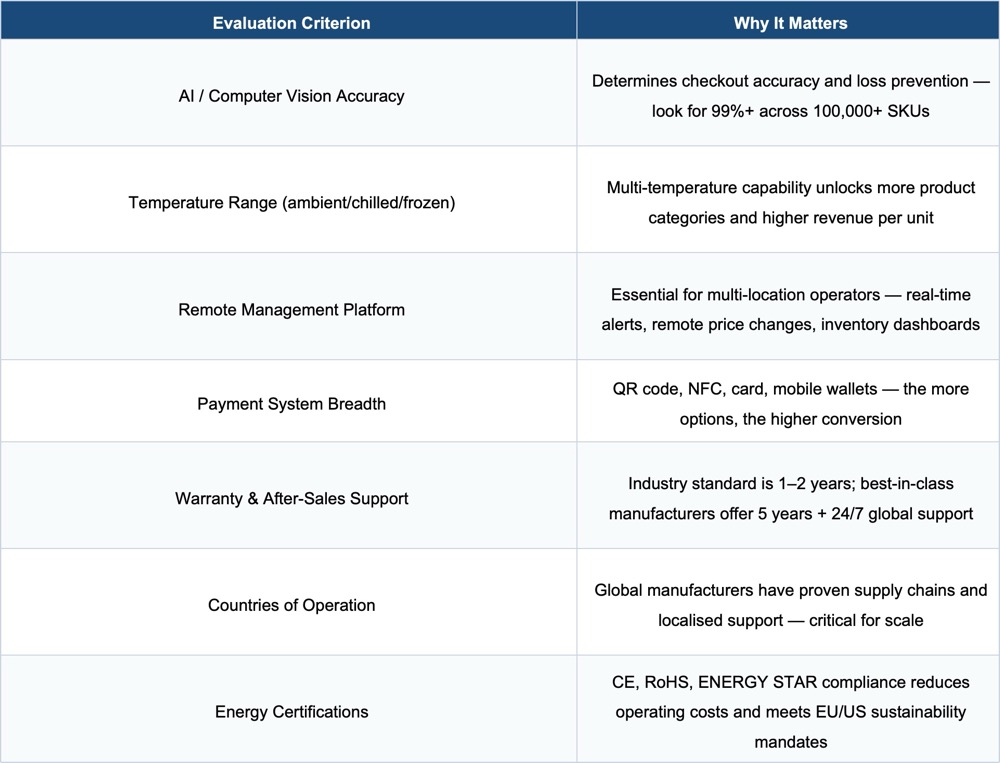
Among the leading vending machine manufacturers globally, SandStar (en.sandstar.com) stands out for its AI-first architecture. Unlike conventional vending equipment manufacturers who retrofit scanning hardware onto existing mechanical designs, SandStar builds from the AI layer up — resulting in zero recognition fees, 10-second checkouts, and 99%+ accuracy across 100,000+ SKUs. The company serves 25+ countries, is trusted by over 30 Fortune 500 companies including PepsiCo and Unilever, and offers an industry-leading 5-year warranty with 24/7 global support.
5. Vending Machine Purchase: Complete Cost Breakdown for 2025
Making an informed vending machine purchase requires understanding both the upfront capital cost and the ongoing operational expenses. Here is the complete picture:
5.1 Machine Purchase Price Ranges
- Used bulk/candy machines: $50 – $500 (minimal tech, cash-only, ideal for low-risk entry)
- Standard new snack/beverage machines: $2,000 – $6,000 (mechanical dispensing, basic cashless)
- AI-powered smart vending machines with touchscreen: $6,000 – $15,000+
- Specialty frozen/fresh food machines: $4,000 – $10,000+
- AI Retrofit Kit (to upgrade existing coolers): significantly lower than new machine cost — SandStar’s solution
5.2 Ongoing Operational Costs
- Initial product inventory: $200 – $800 per machine
- Location commission to property owner: 5% – 25% of gross sales
- Transportation and installation: $200 – $1,000
- Annual insurance: $300 – $600 per machine
- Electricity: $20 – $50 per month per machine
- Maintenance reserve: $200 – $500 per year
- Credit card processing fees: 2% – 4% per cashless transaction
- Business licenses and permits: $100 – $500 per year (varies by US state / EU country)
5.3 Revenue Potential
Revenue depends heavily on location, product selection, and machine type. Based on industry benchmarks (Red Rabbit, Genius Vend, 2025):
- University campuses: $2,800 – $4,200 per machine per month
- Corporate offices: $1,500 – $3,500 per machine per month
- Airports and transit hubs: $3,000 – $6,000+ per machine per month
- Gyms and leisure centres: $800 – $2,000 per machine per month
6. SandStar: The AI-Powered Vending Machine Built for 2025 and Beyond
SandStar’s AI Vending Machine platform represents the synthesis of every trend shaping the vending machine industry in 2025. It is not simply a smarter version of a traditional vending machine — it is a fundamentally different category of unattended retail technology.
- Zero recognition fee model: AI-native product identification means operators pay no per-transaction recognition charge — unlike RFID or barcode systems.
- 99%+ accuracy across 100,000+ SKUs in real-world, multi-product environments.
- 10-second checkout: The customer scans or taps to open, takes what they want, closes the door, and payment processes automatically in 10 seconds.
- 10-minute new product onboarding: New SKUs are added to the recognition model in minutes, not days.
- Smart Frozen Food System: Purpose-built for ice cream, frozen meals, and frozen beverages — with automated temperature monitoring, central alert system, and automated lockout.
- Smart Snack Kiosk: Flexible planograms supporting any mix of snacks, beverages, and specialty food in a single footprint.
- IP67-rated hardware: Water and dust resistant to industrial standards — deployable in any environment.
- Centralized remote management: Update prices, check inventory, resolve faults, and view sales analytics across your entire vending machine estate from one dashboard.
- 5-year industry-leading warranty + 24/7 global technical support: Operational continuity is guaranteed.
SandStar’s AI Retrofit Kit also allows existing cooler and freezer operators to upgrade their current machines into fully AI-powered smart vending machines — an accessible entry point that reduces capital expenditure while delivering the full intelligent vending experience trusted by PepsiCo, Unilever, and 25+ Fortune 500 companies worldwide.
Frequently Asked Questions About Vending Machines
FAQ 1: How much does a vending machine cost to purchase in 2025?
Vending machine purchase prices range from $50 for a used bulk candy machine to over $15,000 for a top-tier AI-powered smart vending machine. A standard new snack or beverage machine falls between $2,000 and $6,000. AI-powered machines with touchscreens, remote management, and computer vision checkout start around $6,000. Additional launch costs include initial inventory ($200–$800), transportation and installation ($200–$1,000), and annual insurance ($300–$600). Lease-to-own options are also available from major vending machine companies, reducing upfront capital requirements. Sources: Genius Vend, WiderMatrix, CottonCandyVending (2025).
FAQ 2: What are the different types of vending machines and which is most profitable?
The main types are beverage machines (largest category, 42–54% market share), snack and candy machines, combo snack+beverage units (42% of installed base — most profitable per square foot), frozen food and ice cream machines, fresh food machines, and specialty/AI smart machines. For new operators, a combo snack and beverage vending machine in a high-traffic location offers the best balance of low risk and strong return. AI-powered open-shelf machines offer the highest ceiling for revenue, especially in corporate and hospitality settings.
FAQ 3: What should I look for when choosing between vending machine manufacturers?
Evaluate vending machine manufacturers across six dimensions: AI and product recognition accuracy (look for 99%+); temperature range (ambient, chilled, and frozen capability); remote management and IoT integration; payment flexibility (cash, card, NFC, QR, mobile wallets); warranty length and 24/7 support availability; and global deployment track record. SandStar meets all six criteria, with 5-year warranty coverage, round-the-clock global support, and proven deployments across 25+ countries for clients including PepsiCo and Unilever.
FAQ 4: Are vending candy machines still a viable business in 2025?
Yes — vending candy machines remain profitable, particularly in schools, amusement parks, cinemas, and shopping centres. Used bulk candy/gumball machines can be purchased for as little as $50 and generate up to $30 per month per unit in prime locations with near-zero operating costs. However, consumer preferences are evolving: sales of traditional candy bars and heavily processed snacks are declining in favour of protein bars, premium confectionery, and healthier alternatives (Accio Research, 2025). Operators who blend classic candy offerings with healthier snack options consistently outperform those who rely solely on traditional product mixes.
FAQ 5: What is vending machine design and why does it matter for sales?
Vending machine design refers to the physical format, interface layout, product presentation, technology integration, and branding of a vending unit. Good vending machine design directly impacts conversion rates and average transaction values. Open-shelf designs outperform traditional coil-and-slot machines because customers can see, touch, and freely select products — reducing purchase hesitation. Large interactive touchscreens increase up-sell and cross-sell rates. Energy-efficient LED lighting improves product visibility while cutting electricity costs by up to 25%. Branding-ready exteriors turn every machine into a marketing asset. In 2025, vending machine design is inseparable from technology: the best-designed machines are also the most intelligently engineered.
Sources & Data References
- Expert Market Research — Vending Machine Market Size & Share (2025–2035): expertmarketresearch.com
- Mordor Intelligence — Vending Machine Market Report (January 2026): mordorintelligence.com
- IMARC Group — Vending Machine Market Size, Share & Forecast (2034): imarcgroup.com
- Grand View Research — Retail Vending Machine Market (2033): grandviewresearch.com
- Precedence Research — Vending Machine Market Size (2035): precedenceresearch.com
- Market Reports World — Vending Machine Market Size & Trends (2034): marketreportsworld.com
- Accio Research — Intelligent Vending Machine Trends & Snack Machine Trends (2025): accio.com
- Genius Vend — Smart Vending Machine Cost Guide & Best-Selling Products (2025): geniusvend.com
- WiderMatrix — Vending Machine Cost Guide (2025): widermatrix.com
- Swoop Funding / Nav — How to Start a Vending Machine Business (2025–2026): swoopfunding.com; nav.com
- SandStar AI Vending Machine — Product & Technology Platform: en.sandstar.com/smart-vending-machine.html
Ready to invest in the smartest vending machine available? SandStar’s AI-powered smart vending platform offers zero recognition fees, 99%+ accuracy, a 5-year warranty, and 24/7 global support — trusted by PepsiCo, Unilever, and 30+ Fortune 500 companies in 30+ countries. Request a demo at en.sandstar.com and discover what real AI retail looks like.